
Where did life come from and how far can it go?
I’ve been captivated by an idea about half a year, ever since I first watched a Long Now video entitled An Informational Theory of Life featuring a theoretical physicist named Sara Imari Walker. In it, she introduced a series of ideas I haven’t been able to get out of my head springing from a new concept in theoretical physics she calls Assembly Theory.
Walker has been developing this theory with biochemist Lee Cronin, and I’m going to try to explain it as simply as I can, and why I think it’s such a big deal.
We’re all familiar with Darwin’s theory of natural selection, where lifeforms with beneficial mutations tend to survive and reproduce, gradually outcompeting others — a process we call evolution. But Darwin’s theory applies only to biological creatures. Walker pushes this idea further back in time, proposing a kind of selection that precedes biology.
She thinks in terms of chains of causality, the developmental history of objects, where simple things combine to form more complex things. Imagine building castles or spaceships out of Lego blocks: most combinations are random and useless, but a few create stable structures that can support further complexity.
When basic molecular building blocks combine, most just fall apart. But some are stable enough to persist, and eventually get reused to build even more complex structures. When that happens, certain components begin showing up frequently — because they work. Assembly Theory calls this the Copy Number — how often a particular structure appears. A high copy number suggests a stable foundation.
As structures become more complex, they accumulate a kind of history. Assembly Theory measures this through the Assembly Index — the number of steps required to build something from its most basic parts. The higher the index, the deeper its causal history.
This has real-world implications. For example, if we detect an object — or even a mix of molecules in an exoplanet’s atmosphere — with both a high copy number and high assembly index, it might be a signature of life.
That might not sound so amazing on the surface, but the implications are profound. It suggests that life emerges not from a single lucky accident in a warm pond, but from scale and repetition. Walker argues that life needs a planet, not just a particular favorable location. You need a large enough spread of building blocks across time and space to allow the assembly process to repeat, fail, and succeed enough times to build complexity.
And the kind of life that results is likely to be vastly different from planet to planet. Some might never achieve the scaffolding needed for life. Others might evolve wildly different forms.
There’s another mind-bending idea in Assembly Theory: it redefines time. In this model, time isn’t just the changing of the seasons or a gradual increase in entropy; it’s a measure of assembly. The more complex an object is, the longer its causal chain — which means the most complex things are the oldest in assembly time.
Humans have only been around for a few hundred thousand years — a blink in planetary history — but in assembly time, we’re ancient. That’s because our complexity rests on chains of prior assembly going back billions of years. Compared to bacteria, which haven’t changed much in structure, we are far older, not in chronology, but in accumulated structure.
And it gets even weirder.
We’re not at the peak of assembly time anymore. The forms of complexity that emerged from us — our technologies — are even more deeply scaffolded. We’ve engineered rocks to manipulate electricity (silicon chips), built systems that interact with us, learn from us, and operate globally. The internet, in assembly terms, is one of the oldest things we’ve made. And our most advanced AI systems, GPS networks and chatbots which many of us interact with on a daily basis, are extensions of this deep causal history.
There’s much more to Assembly Theory than I’ve covered here, and I highly recommend watching Sara Walker’s talk at the Long Now for a more complete picture.
Let me switch gears for a moment to another Long Now speaker: NASA astrobiologist David Grinspoon. His book Earth in Human Hands was as eye-opening to me as Walker’s Assembly Theory.
His key argument is that humans have been geoengineering the Earth for far longer than we think — not just since the Industrial Revolution or climate change, but since we developed language, agriculture, and tools. We’ve been reshaping our planet unintentionally for millennia — without understanding the consequences.
But here’s the hopeful part: we’ve also developed tools to understand those consequences, and even reverse them. Take the Montreal Protocol in 1987 — an international agreement to stop using CFCs that were destroying the ozone layer. It worked. The ozone hole is healing. It’s one of the few real examples of planetary-scale cognition in action.
I recently became aware of a 2022 paper which Grinspoon co-authored with Walker and astrophysicist Adam Frank, titled Intelligence as a Planetary Scale Process. It re-frames intelligence as not just a human trait, but as something that emerges from the interactions between biology and technology at a planetary level.
The authors argue that the Anthropocene, this moment of planetary crisis and transformation, is not just an environmental phase. It’s part of the planet’s cognitive evolution.
This view positions humans as an integral part of an emergent planetary intelligence. Just like adolescents tearing up the neighborhood, but hopefully one day becoming mature enough to produce offspring that can go further than their parents
Now do you see where I’m going with the title of this post?
In 1979, James Lovelock introduced the Gaia Hypothesis, suggesting that Earth is a self-regulating system. Critics pounced on the idea that he was suggesting a conscious Earth, and dismissed it as mystical woo.
But someone else picked up the thread, our old friend Isaac Asimov, and ran with it.
In 1982, just three years after Lovelock published Gaia, Isaac published Foundation’s Edge, where he introduced a planet named Gaia; a world that was literally conscious, where all beings were networked into a shared planetary mind. The book even teases a vision of Galaxia, a future in which all humans are connected in a vast, galactic intelligence.
Grinspoon, Walker, and Frank aren’t predicting a hive mind. But they are suggesting something almost as radical, that intelligence, at its deepest level, might be a planetary process. Something we participate in, but don’t fully control.
Another thinker, techno-futurist philosopher Benjamin Bratton, expands this even further. He also spoke at Long Now, and I’ll save a fuller discussion for another post. But in short: Bratton views the planet’s technological infrastructure; its satellites, sensors, data centers, networks, as a new cognitive layer, enabling Earth to begin thinking about itself.
It’s through these systems that we’ve understood climate change, tracked global events, modeled the future. In a very real sense, we’ve already given birth to a kind of planetary meta-cognition.
We don’t even fully understand how consciousness arises within our own minds. Neuroscientists like Antonio Damasio have proposed that meta-cognition — the ability to reflect on our own thinking — doesn’t stem from a single mechanism, but from the integration of many interacting systems: perception, memory, emotion, embodiment. None of these, alone, accounts for self-awareness. But together, they scaffold a new phenomenon: a mind that knows it has a mind.
Assembly Theory gives us a way to frame this. The more steps required to construct a structure, the deeper its causal history, the higher its Assembly Index. A mind capable of meta-cognition is an extraordinarily high-index structure, formed from layers upon layers of interlocking systems, stretching back across biological evolution.
Now zoom out. Bratton describes something he calls The Stack, made up of layers of planetary infrastructure, computation, and sensing. What if these systems, like the components of our own brain, are scaffolding toward something greater? The satellites monitoring climate, the data centers modeling the Earth’s future, the language models interpreting human knowledge, each may be a node in a larger process. Not just communication, but integration.
If a high assembly index reflects the depth of history embedded in a structure, then perhaps planetary meta-cognition will be among the most ancient things ever assembled — because it will contain everything that came before: biology, technology, thought. It won’t emerge from nowhere. It will emerge from us, through the systems we’ve built, yet go far beyond what we can currently comprehend.
Meta-cognition may have been the threshold that made us human. What if we are now assembling, step by step, the next great threshold — the one that makes a planet aware of itself?
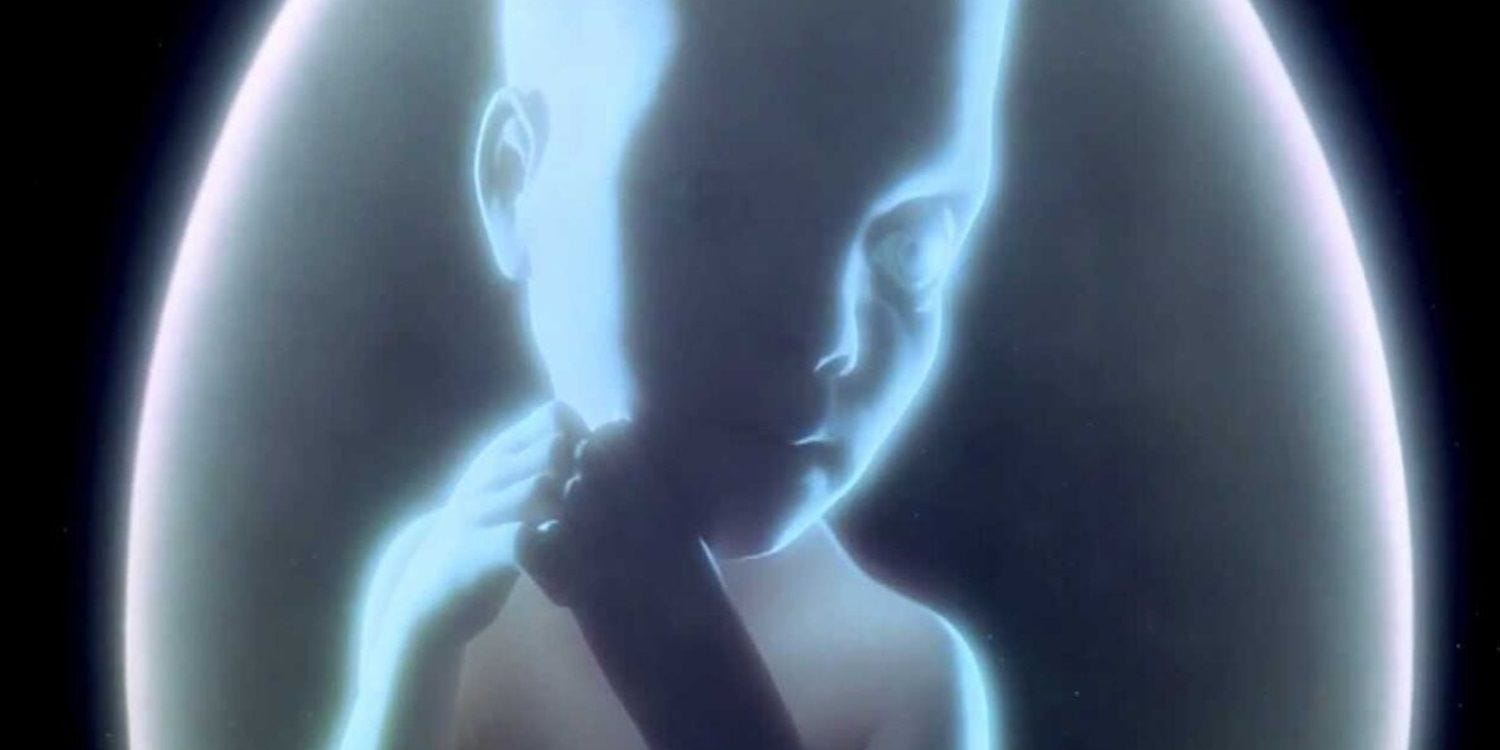
It’s very exciting to imagine that we may all be alive for the birth of a star child like we saw at the conclusion of Stanley Kubrick’s 2001: A Space Odyssey. Could a true planetary mind be, at this very moment, kicking in the womb?
Maybe Lovelock was just a little ahead of his time. We know Asimov was!
Why does it matter? is a follow-up post to this one.