
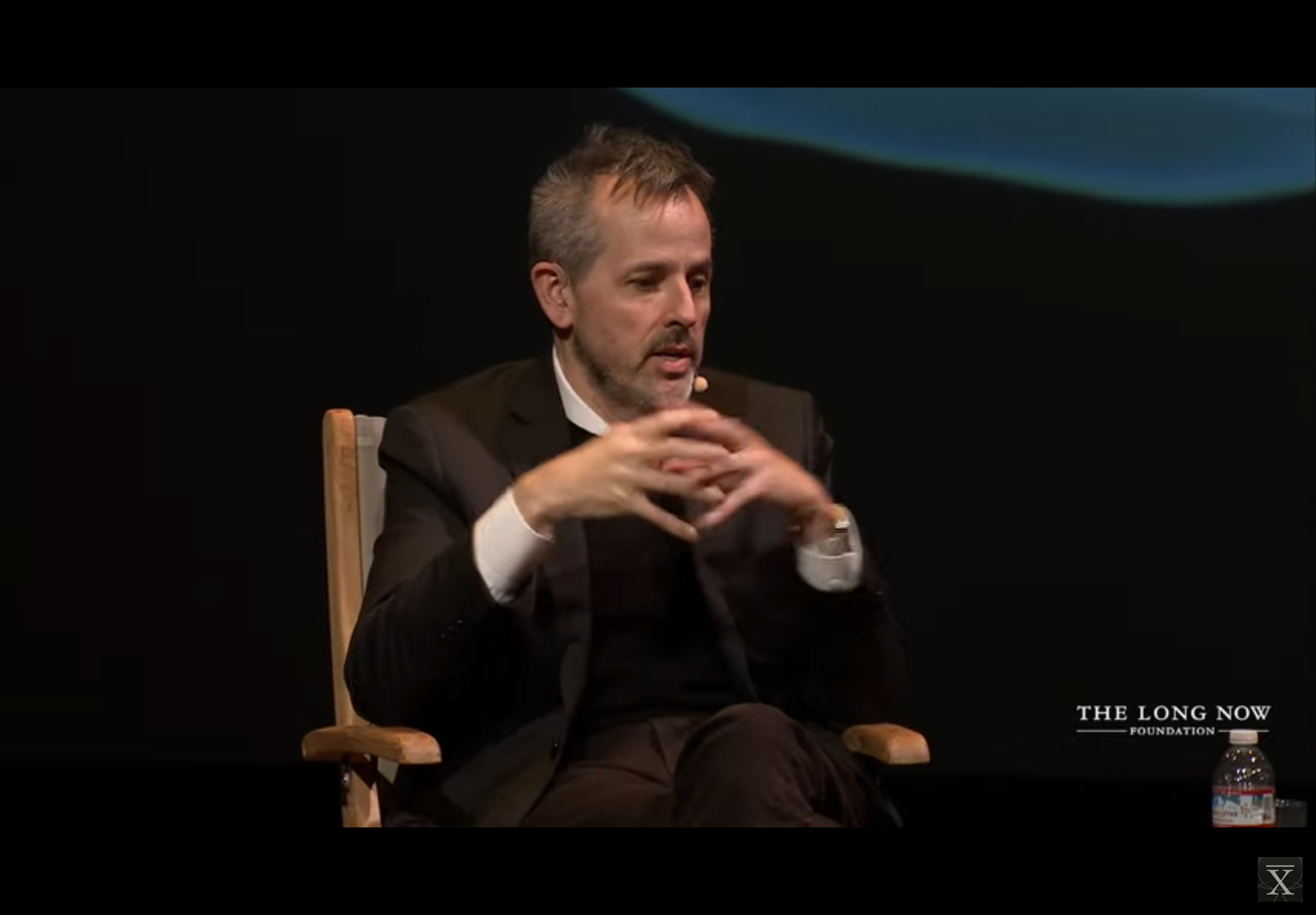
I discovered philosopher of technology Benjamin Bratton last year via a recording of the Long Now Foundation’s appearance by Sara Imari Walker on her ideas about Assembly Theory and a novel approach to understanding the emergence of life on this planet. Bratton was the host of the talk and gave an intro in which he invited the audience to prepare for a “wild ride” and laid out the main concepts of assembly theory in a highly engaging way. At the end of that wild ride, he engaged Walker in a Q&A that might have been an even wilder ride than her talk. Since then, I’ve listened to his own Long Now talk and several other podcast appearances, some of them multiple times.
Bratton’s ideas are bold and exciting, and I very much look forward to seeing him for the first time this evening, when he will appear in San Francisco for a lecture updating his concept of The Stack, a way of conceptualizing the Earth’s growing techno-social infrastructure in the age of planetary computation, describing six layer comprising the stack of Earth, Cloud, City, Address, Interface and User. I intend to update this post with my thoughts upon its conclusion, and hope that I might even be called upon to answer a question or two.
I’m very curious about the intersection of his ideas regarding infrastructure development and Walker’s assembly theory, particularly as it applies to the idea of designing a new city in California. The Forever California project is attempting exactly this, with a plan to create a new city of 400,000 inhabitants in the delta region between SF and Sacramento. The idea is to solve a lot of urban planning problems by planning out the city from scratch and at a large scale, including affordable housing, extreme walkability, incredible public transit, and a sustainable energy infrastructure including solar power and heating and cooling at a city wide scale. It sounds fantastic and utopian, but…
I worry about it appearing overly planned and kind of boring. Cities are usually brought to life organically over time, with different neighborhoods establishing their unique style and flavor — for better or worse. Different eras of building show the predominant architectural themes of the time they arise, and the city’s identity is established through the makeup of the various groups of people that come to inhabit it. Could a totally designed city have its heart and soul designed on the drawing board? I’d love to hear what Brannon thinks of such a project, and how his affinity with the ideas of assembly theory map to efforts like this. I expect he would believe that a scaffold can be built for something like this, but that the possibilities for what is built on top of the scaffold must be open and not predetermined.
Stay tuned for my later comments after his talk tonight.
If you are interested in hearing more about the Forever California project, The Volts podcast hosted by David Roberts recently did two episodes covering it in depth featuring the lead designer Jan Sramek.
