

Hober Mallow and the Question of the Future
There is a moment near the end of The Merchant Princes, the fifth story in the first novel of the Foundation series, that I have always found very intriguing. It is not really related to the compelling plot itself. It happens in the last few paragraphs, after Hober Mallow’s trial for sedition has been dramatically resolved in his favor. I quoted it in the corresponding story episode on the Seldon Crisis podcast at the time, and I will repeat it here again.
The context is that Mallow’s close friend and associate, Ankor Jael, asks him what the future holds for them and for the Foundation after the successful conclusion of the trial. Mallow responds:
“What business of mine is the future? No doubt Seldon has foreseen it and prepared against it. There will be other crises in the time to come when money power has become as dead a force as religion is now. Let my successors solve those new problems as I have solved the one of today.”
In my commentary, I noted how this felt like a curious meta-reference. Mallow is a character in a story ostensibly written by Hari Seldon, who famously predicted how events would transpire over the course of a thousand years. Mallow, as an individual, is only playing his part in that grand narrative. It almost feels as though the true author of the story, Isaac Asimov, is winking at the reader. Asimov is the real author, and all of the characters, no matter how much agency they appear to have, are ultimately his playthings.
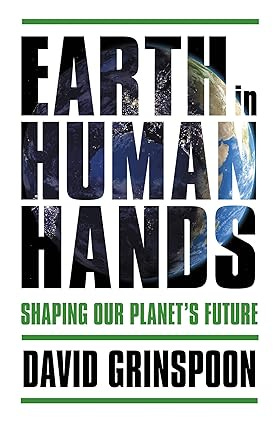
Earth in Human Hands
I was reflecting on this passage while thinking about a book I briefly discussed a couple of posts ago, Earth in Human Hands, written by astrobiologist David Grinspoon and discussed in Assembling Gaia. Grinspoon’s thesis is that the Anthropocene, the current epoch of planetary time in which a single species has become so influential that it is altering the biosphere in significant and lasting ways, represents an inflection point.
Until relatively recently, we assumed we were incapable of changing the planet in any meaningful way. Science has revealed that assumption to be false. Our technologies have created serious problems that we now must address, not only for our own good, but for the benefit of the many other species that inhabit this planet.
A perfect example is the discovery that chlorofluorocarbons released from refrigerants and aerosols were damaging the ozone layer above the South Pole. Once this became clear, it was imperative to change our technological practices in order to restore this essential shield from ultraviolet radiation. Humanity responded quickly. The Montreal Protocol was passed in 1987, and it was successful in initiating the recovery of the ozone layer.
Becoming Aware of Planetary Consequences
We have since become aware of much more damage that we have caused to the planet, much of it not easily undone. In 1962, environmental scientist Rachel Carson wrote Silent Spring, documenting the ecological damage caused by pesticides such as DDT. In 2009, climate scientist James Hansen published Storms of My Grandchildren, with its haunting subtitle, The Truth About the Coming Climate Catastrophe and Our Last Chance to Save Humanity.
Though these works were met with detractors at the time, and still are, climate modeling and observational data have made it clear to most that humans have had a profound impact on Earth’s systems. We have a great deal of work to do to repair the damage we have caused.
How does all of this relate back to Asimov and his character, Hober Mallow?
From Pack Leaders to Mythic Authority
To explain the connection, we need to go much further back in time, to before humans even arose on this planet.
We evolved from a lineage of primates that also gave rise to chimpanzees and bonobos. These species, like early humans, lived in small hunter-gatherer bands, typically ranging from 20 to 150 individuals. Humans differed from our primate cousins in one crucial way: our anatomy supported the development of complex spoken language, possibly related to physiological shifts associated with bipedalism.
Language added enormous complexity to social dynamics. Effective hunts required strong leadership. Disputes required skilled negotiators. Language allowed essential knowledge to persist across generations in a way no other species could match.
Anthropologist Christopher Boehm, in Hierarchy in the Forest, points out that early human groups also diverged from other primates in their attitude toward leadership. Strong leaders were tolerated only as long as they served the group. Tyrants were mocked, exiled, or killed. Humans did not evolve to blindly follow alpha leaders in the way wolves do, for example.
Myth as a Coordination Technology
Humans have existed for at least a couple hundred thousand years, and while we do not know exactly when language emerged, its appearance had profound consequences. Over tens of thousands of years, a powerful transformation occurred. Language, story, and myth gradually replaced the direct authority of pack leaders with imagined ultimate authorities.
This shift allowed human societies to grow far beyond small-group structures. Large sedentary settlements emerged, followed by towns, cities, and eventually nations. These larger societies were united by shared beliefs in an ultimate authority, creating common identities held by thousands, then millions.
Myth externalized authority. Gods, cosmic order, and moral hierarchies emerged. No single human needed to be obeyed absolutely because everyone was subject to the same overarching story. This pattern can be seen in Mesopotamian divine kingship, Egyptian Ma’at, and Abrahamic covenantal law. These beliefs were eventually preserved in written form and widely disseminated, reinforcing social cohesion.
This is not to say that myth and religion were false or misguided. They were highly effective. They functioned as coordination technologies for large-scale societies, enabling capabilities far beyond those of small hunter-gatherer bands.
The Axial Age and the Rise of Reason
Another major transformation occurred during the period known as the Axial Age, roughly from 800 to 200 BCE. Influential thinkers emerged across the world, including Confucius and Lao Tzu in China, the Buddha in India, Greek philosophers in the Aegean, and Hebrew prophets in the Levant.
These thinkers began shifting societies away from purely mythic explanations toward ethical and rational frameworks, though mythic elements remained woven into their ideas. Out of this period arose enduring institutions such as the Catholic Church, large mythic-ethical states, and novel political systems like Athenian democracy.
Several centuries later, another shift followed with the emergence of natural law and Enlightenment thinking. Appeals to divine authority were increasingly replaced by logic and reason. These approaches proved extraordinarily effective at producing technological advances that transformed societies and improved living standards.
Narrative authority did not disappear. Instead, it migrated. God’s assumed responsibilities were absorbed by secular concepts, national destinies, heroic leaders, political movements, and visions of utopia and revolution.
When gods retreated as the dominant source of authority, humans replaced them with Parties, Markets, Leaders, and, in the imagination of one brilliant science fiction writer, a man named Hari Seldon.
The Absence of a Grand Author
Only in the late twentieth century and into our own has a more unsettling idea begun to take hold. Perhaps there was never a grand story writer at all. Perhaps we have always been on our own, subject to chance and contingency, with no ultimate narrative to guide us.
For many, this realization is terrifying. It invites retreat into distraction, comfort, or trivial meaning. Sports fandom, celebrity worship, television narratives, and other diversions become surrogate stories, knowingly artificial yet emotionally sustaining.
Grinspoon, and others like him, suggest something more hopeful.
Assembly, Contingency, and the Continuation of Life
Sara Walker and Lee Cronin’s Assembly Theory begins with a simple observation: complexity exists because of selection acting over time. Basic combinations of elements form structures that repeat and scaffold ever more complex forms, eventually giving rise to organisms capable of understanding their own origins and extending that process further.
Life explores assembly space, but not freely. It is constrained by what came before. Path dependence matters. This is the real story beneath it all, and it is extraordinary.
Intelligence and technology are not ruptures in this process. They are continuations. Life keeps building, with remarkable chapters still to be written, none of which can be reliably foretold.
There is no evidence of a prewritten cosmic script for human flourishing. Like Asimov himself, writing from the seat of his pants, life continues to write its story as it goes.
Meaning, in this view, is not bestowed. It is emergent, contingent, and authored by agents within constraints. We create meaning through our actions and through how we choose to continue the story.
Reimagining the Self
At this point, I want to introduce a key idea from a modern thinker whose work has strongly influenced this essay. Indy Johar is someone I had the privilege of hearing speak at the Long Now just a few days ago. I highly recommend his recent essay, Reimagining the Self in Enlightened Self-Interest.
If Grinspoon shows that humanity has become a planetary force, and Assembly Theory shows that our future is contingent rather than ordained, then the remaining question is psychological. What kind of self is capable of acting at that scale?
Johar argues that the problem is not selfishness as it is commonly understood. The problem is that we think far too narrowly about what the self actually is. We imagine the self as bounded by our brain and body, perhaps extended slightly into our past actions and personal identity.
Johar challenges this framing. Our true self is much larger, both in space and in time. It extends outward through relationships, communities, and shared knowledge. It reaches into tools, devices, and distributed digital systems. In some sense, our self is as large as we are capable of imagining it.
Our past clearly forms part of who we are. But what about our future? When we extend our sense of self forward in time, including our descendants and the conditions that will sustain them, the scope of responsibility changes dramatically.
Planetary Agency and Collective Responsibility
This brings us back to Grinspoon’s idea of planetary agency. We need an ecological self alongside a personal one, because our broader self includes the systems that sustain us. In a world without a divine storyteller, responsibility shifts inward and outward at once.
Our task is to adopt a sense of self large enough to match the scale of our influence.
The Future Is Everyone’s Business
Finally, we can return to Hober Mallow and his question: “What business of mine is the future?”
In a story not written by Seldon, Asimov, or God, the answer is that the future is everyone’s business. There is no one behind the curtain to create it for us or to blame when it goes wrong.
The people of the Foundation were compelled to surrender their agency to a predicted future. Real people, with real agency and selves that extend across space and time, must assume responsibility for an unpredictable one.
None of us is writing the story alone. It is a collective enterprise. And to me, that is not a source of despair, but a profound source of meaning.
I believe that we may be in a Seldon crisis, or pre crisis anyway.
I don’t know whether nuclear war or the next pandemic will precipitate it but our over reliance on our present technology will be the cause.
It would not take many people to not go to work for our present infrastructure to crumble. It would only take a few days without electricity for our cell phone system to fail. A little longer for us to have no access to the internet. Add no running water and sewer system and we are quickly back to the Middle Ages.
Why is this a problem?
All of humanity’s knowledge base is in the internet. This includes repair and operating manuals and we would have no access to it.
Seldon called for the creation of an encyclopedia and a cadre of intellectuals. I think that, at least, this potential crisis calls for an investment in libraries and maybe in a civil defense force.
Thoughts?