
This is a follow-up post to Assembling Gaia.
So some scientists came up with a new idea about how life developed, and others take this and similar ideas to ponder where it might be going. Why is this worth thinking and writing about?
To me, I suppose it’s because I’m not really convinced that we, the humans on this particular planet, are all that special. Yes, as far as we know, we are the only creatures to acquire a large number of unique features. We seem to be the first and only animals to learn to speak to one another, to build sophisticated tools, to record our thoughts for posterity, to create astounding works of art, music, and architecture, and to even learn how to go beyond our atmosphere and visit distant worlds.
Most of all, we seem to be the only species that knows that we know, that ponders why we came to be, that creates stories and legends and dreams of greater things. All the others seem content to simply thrive as biological beings. Perhaps many have emotions, feel love for their kin, terror when threatened, suffer when hurt or ill, and have an inherent dignity as living things to be honored and respected. Some even become parts of our family, and develop deep bonds with us.
We humans, however, seem to be at the height of a pinnacle of achievement. We are brilliant, shining miracles in the sea of life. Nothing is remotely like us. It’s very easy to see how notions arise that this entire universe was made for us, and that we are the chosen recipients of all of its glory.
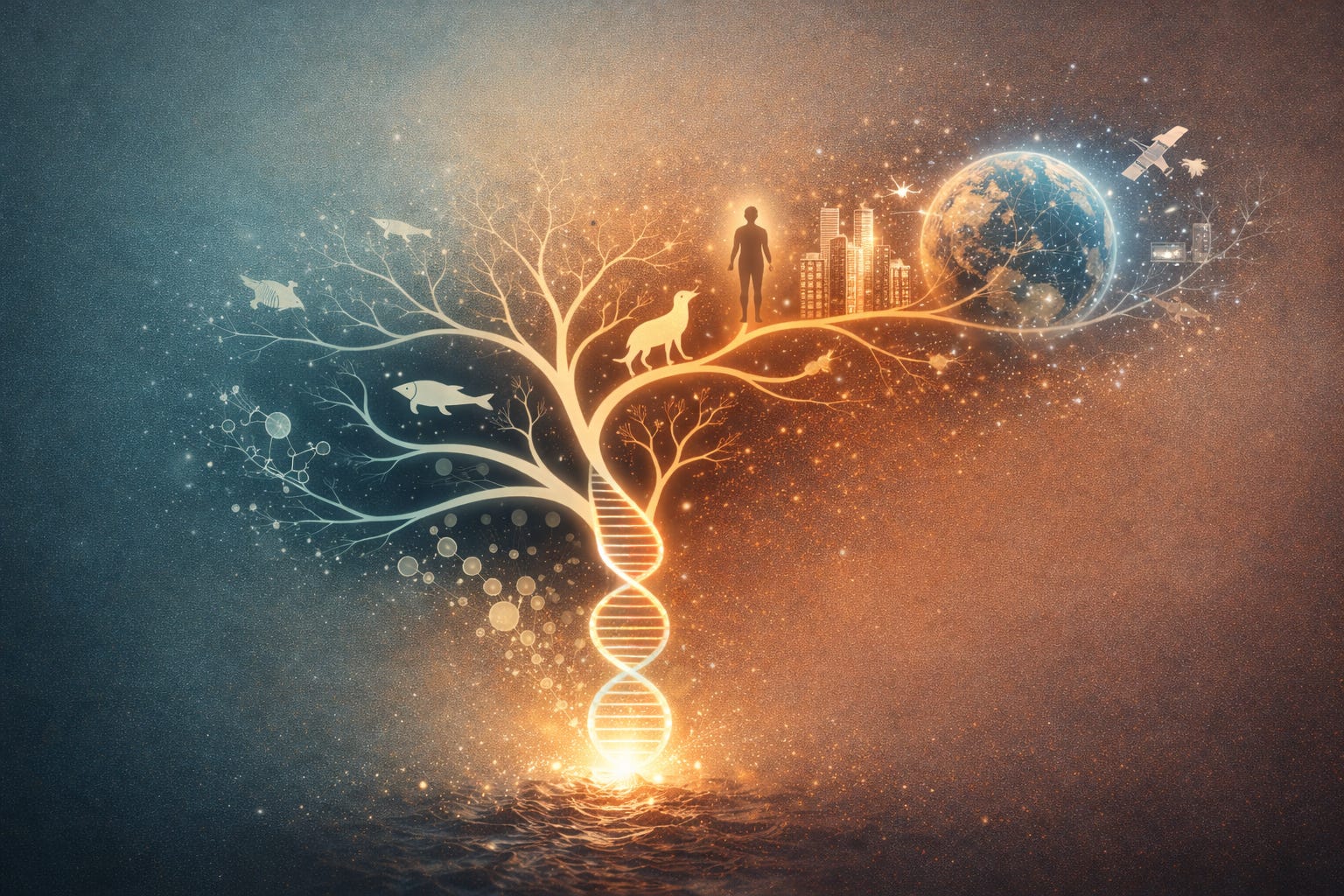
From an evolutionary perspective though, we are just at the height of creation momentarily. Evolution was not programmed to end with us. We are at the end of a single branch, a twig, a leaf, of a tree that there is no reason to think has stopped growing. Though the life on other branches might seem comparatively less impressive, these branches also will continue to evolve. The progress of most may terminate before reaching much further — regrettably often at our hands — and some may mutate and develop into new forms no one could expect, even possibly attaining capabilities we thought were ours alone.
Ultimately, it is life itself that I find truly wondrous, and it is life’s progress and future that I find so exhilarating. If life were to end with we humans as we currently find ourselves, that would be an amazing story, but ultimately a little disappointing. It would be as if we entered the most amazing theatrical venue ever conceived, only to find that the actors were moments away from taking their final bows, or to arrive at the party of all parties only to find the hosts handing the guests their coats at the door.
Assembly theory is amazing to me because it implies that there is so much more ahead for life, and so much incredible variety for life in the universe beyond this planet. The core idea of a scaffold, a foundation to build upon, again and again, to powers of intelligence beyond our conception, from every fertile planet in every galaxy, truly boggles the mind. It means that the wildest ideas of science fiction are far too tame. We have no idea what is out there, and what will be out there, as life continues its boundless progression in countless forms.
But, you might say, this could all end in tragedy if we don’t get our heads out of the clouds and solve the critical day to day issues before us. Yes, I agree that we have serious crises to address that could jeopardize the chance for we humans to make the most of our current position in the hierarchy as the most intelligently advanced beings. I have a family, a community, a country, I care for and want to see sustained. I long for a beautiful life for my child and for those of my friends, and really for all the innocent humans and other creatures to come, and it is important to focus on helping to ensure their ability to thrive on a healthy planet.
But, even if the worst of calamities were to befall us, I have confidence that life will not stop its advancement. It’s possible that this planet is the only one to presently contain life, but I have serious doubt that that is the case, and there is a very good chance that the life here will one day be spread to other worlds. In other words, life is here — in the universe — to stay, and assembly theory helps me to understand why that is the case and why I really don’t need to worry about it disappearing forever. The scaffold has been erected and it will be used, over and over again.
Essentially, to answer the question in the title, I care because I want to understand how all of this came to be and to ponder what it could become. It gives meaning to my existence. That is all.