
Episode Summary
In this episode of Seldon Crisis, host Joel McKinnon is joined by two visionary independent science fiction authors, Tobias Cabral and Erasmo Acosta, for a wide-ranging conversation about possible human futures—and the radically different paths our species might take beyond Earth.
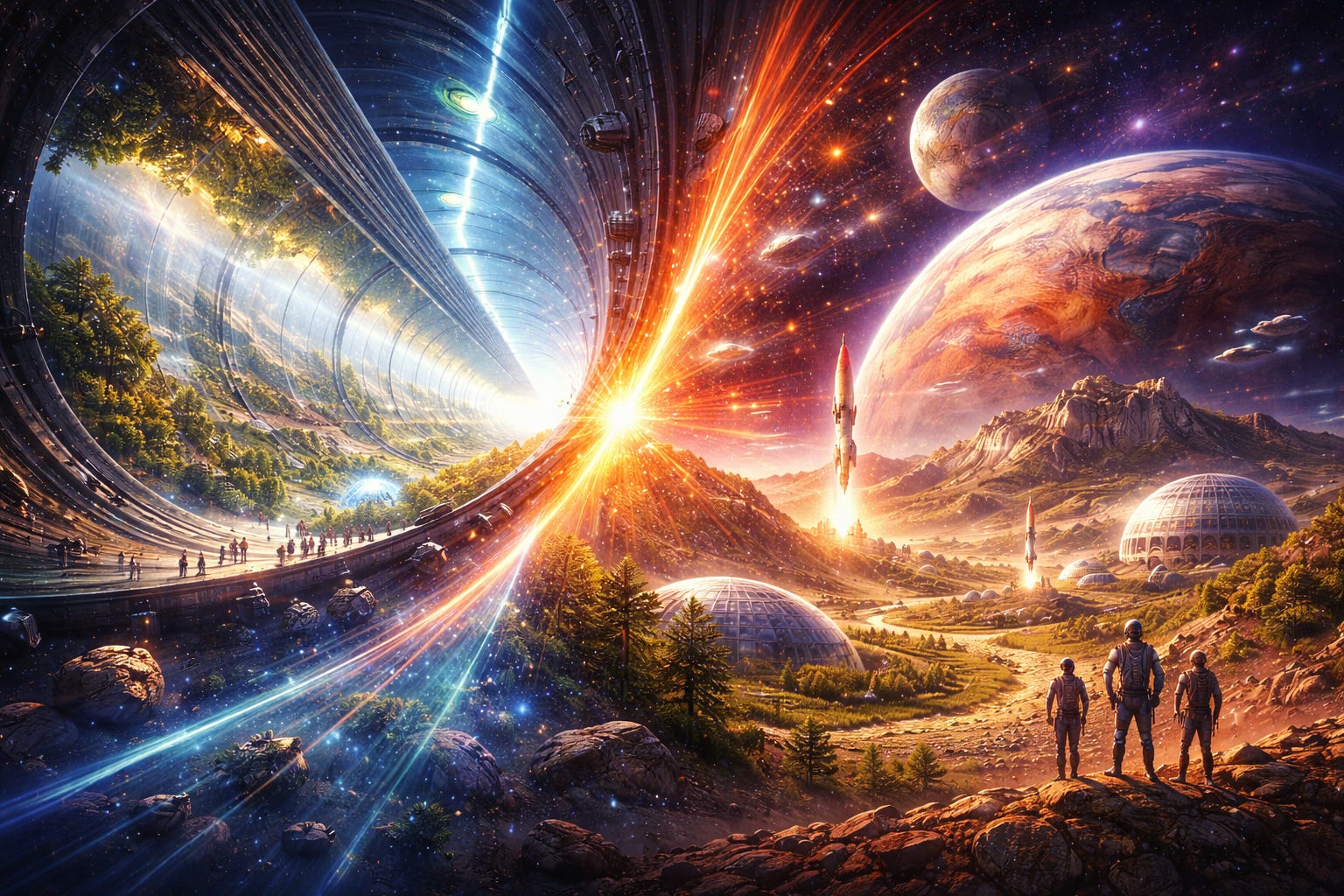
Tobias Cabral envisions humans living in a thriving Mars colony alongside intelligent robots, exploring questions of empathy, artificial intelligence, and moral responsibility. Erasmo Acosta imagines a far more expansive future: a billion years of human evolution across the galaxy, relying on rotating space habitats forming vast Dyson swarms that fully utilize the energy output of their host stars.
Together, Joel, Tobias, and Erasmo explore contrasting models of expansion—planetary settlement versus space-based megastructures—alongside the psychological, cultural, and ethical implications of each. The discussion ranges from the Fermi Paradox and artificial intelligence to stagnation, exploration, and the enduring role of science fiction as a laboratory for thinking about humanity’s long-term prospects.
Active Transcript
Transcripts:
Web (Read/Listen) | PDF | MS Word
Transcripts: Web (Read/Listen) | PDF | MS Word
Tobias Cabral
Mechanical Error
New Eyes
Review of New Eyes by Joel
Enter Darkness
Review of Enter Darkness by Joel
Erasmo Acosta
erasmix.com
Highlights
Introduction of Tobias Cabral and Erasmo Acosta
Joel introduces the episode as a rare two-guest conversation, bringing together authors with sharply contrasting but complementary visions of humanity’s future. Tobias Cabral is introduced as a science fiction novelist with a background in psychology and complexity theory, while Erasmo Acosta is presented as the author of K3+, an epic future history spanning a billion years of human expansion.
Tobias Cabral: Mars, AI, and Moral Responsibility
Tobias discusses his novels Mechanical Error and New Eyes, which explore:
A thriving human civilization on Mars
Intelligent robots and androids interacting with humans
The ethical implications of artificial intelligence and emergent consciousness
Psychological depth, trauma, and moral ambiguity in both heroes and villains
Joel and Tobias discuss how planetary environments—especially Mars—serve as psychologically grounding spaces and powerful symbols for human renewal.
Erasmo Acosta: K3+ and a Billion-Year Vision
Erasmo outlines the ambitious scope of K3+, which imagines:
Humanity transitioning from planetary civilization to space-based existence
Rotating cylindrical habitats inspired by Gerard O’Neill
Dyson swarms capturing the full energy output of stars
Genetic enhancement, neural interfaces, and biological immortality
Thought-based communication reminiscent of Asimov’s Second Foundation
Erasmo argues that planets are fundamentally inefficient for large-scale civilization and that space habitats offer nearly unlimited room for growth.
Planets vs. Space Habitats
A central theme of the episode is the tension between planetary habitation and space-based megastructures. Erasmo challenges what Asimov called “planetary chauvinism,” while Tobias and Joel explore the emotional, symbolic, and psychological importance of living on worlds with gravity, horizons, and landscapes.
Joel positions himself between the two perspectives, advocating for a diversity of futures rather than a single dominant model.
The Fermi Paradox and Cosmic Perspective
Erasmo connects K3+ to the Fermi Paradox, suggesting that intelligent civilizations may be extraordinarily rare due to the improbability of life’s evolutionary path. Tobias counters with cautious optimism, noting that vast cosmic distances and timescales may simply delay contact rather than preclude it.
The discussion echoes themes from Stephen Webb’s Where Is Everybody? and Asimov’s broader speculation about humanity’s place in the universe.
Artificial Intelligence, Complexity, and Ethics
Tobias draws on complexity theory and neural networks to discuss:
AI as an emergent phenomenon rather than a purely engineered tool
The ethical responsibility humans bear toward sentient artificial beings
Parallels between biological evolution and artificial cognition
AI is framed not as an existential threat, but as a moral and relational challenge.
Comfort, Stagnation, and the Need for Exploration
Joel raises concerns about technological comfort leading to cultural stagnation. The group reflects on:
The dangers of overly stable, risk-averse societies
Cyberpunk dystopias versus complacent utopias
Exploration and challenge as drivers of creativity and growth
Mars, space habitats, and unfamiliar environments are framed as antidotes to civilizational plateau.
Notable Quotes
On Space Habitats:
“We can house more people inside rotating habitats around the sun than on all habitable planets in the Milky Way.” – Erasmo Acosta
On AI and Ethics:
“If you create a truly sentient intelligence, your role isn’t programmer—it’s parent.” – Tobias Cabral
On Human Futures:
“I don’t want one future. I want many futures, so we can explore them all.” – Joel McKinnon
Featured Works & Links
Tobias Cabral
Mechanical Error
New Eyes
Review of New Eyes by Joel McKinnon
Neo Cyberpunk, v2
Enter Darkness
Review of Enter Darkness by Joel McKinnon
Erasmo Acosta
K3+
Review of K3+ by Tobias Cabral
erasmix.com
What’s Next for Seldon Crisis
Joel teases the approaching conclusion of “Search by the Mule” in Second Foundation, where long-running storylines converge and the fate of the galaxy hangs in the balance.
Listen to Seldon Crisis
Available on your favorite podcast platforms.
Subscribe on Substack for full transcripts, essays, and future episodes.
Discussion
Which vision of humanity’s future resonates more with you—planetary civilizations, space habitats, or something stranger still?
Join the conversation in the comments.


